Pre-sales diagnostic · Agentic commerce · 2026
Agentic Commerce Readiness Audit
I designed and built a diagnostic that scores whether AI shopping agents can find, understand and buy from a merchant, then benchmarked 70 storefronts with it. A Visa global business unit adopted it for international rollout, and it opened opportunities to pitch merchants their own buyer agents for consumers.
30 / 56
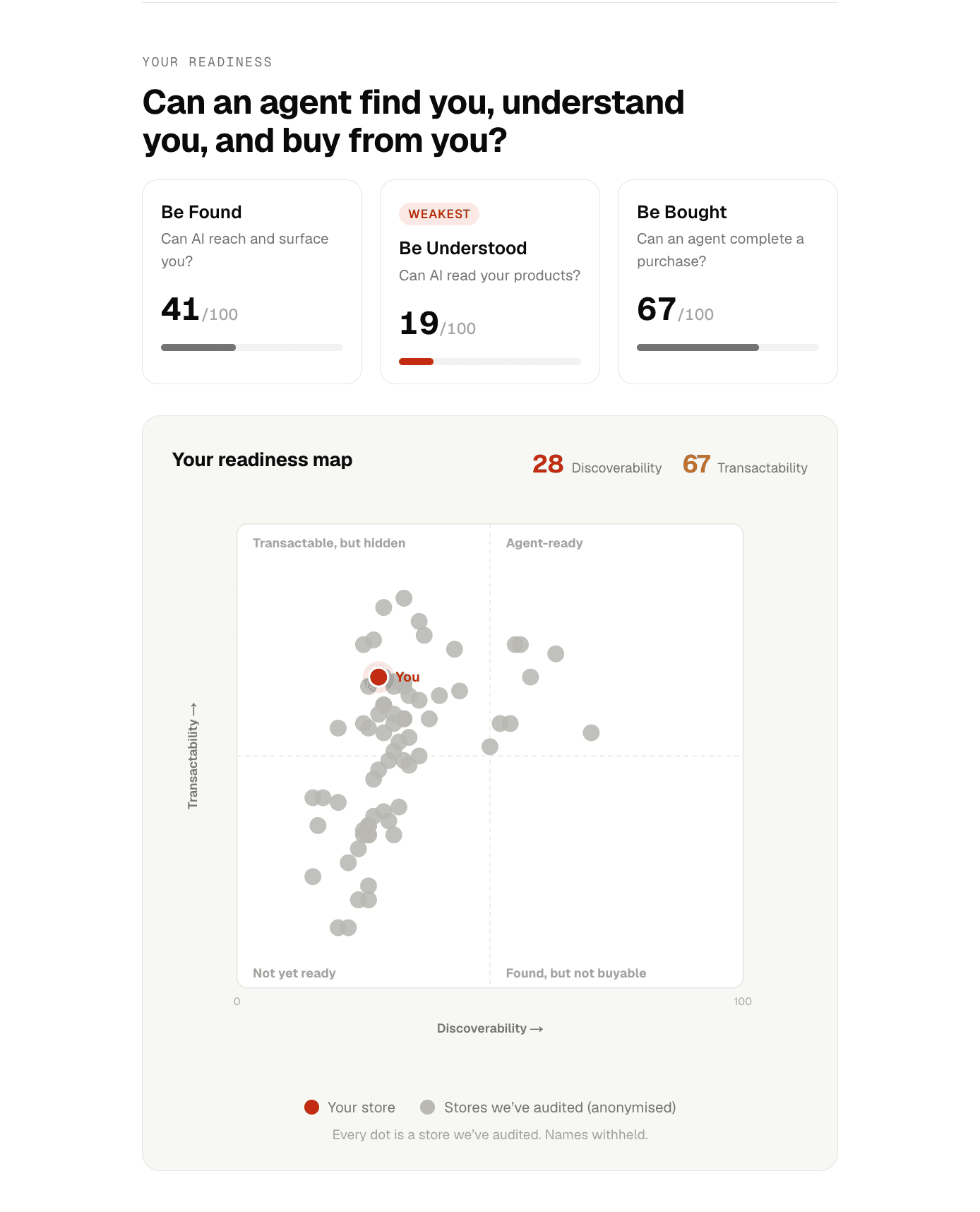
Median discoverability and transactability out of 100, across 70 storefronts
64 of 70
Stores scoring higher on transactability than on discoverability
8 of 70
Stores clearing 50 on discoverability
4
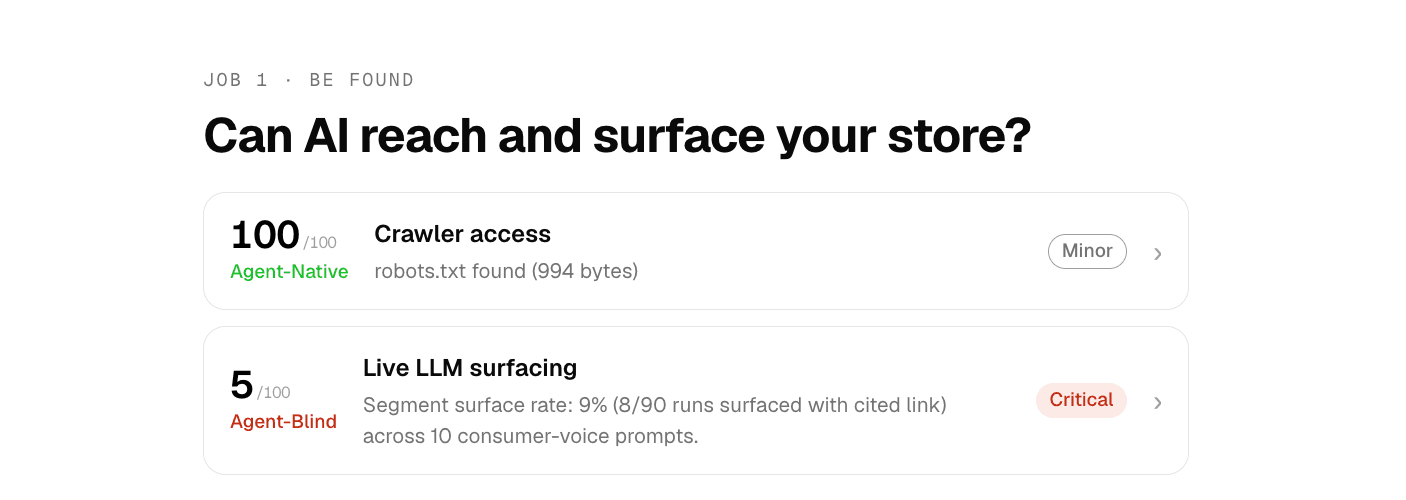
Model providers queried live on every audit, citations checked against the merchant's site
The problem
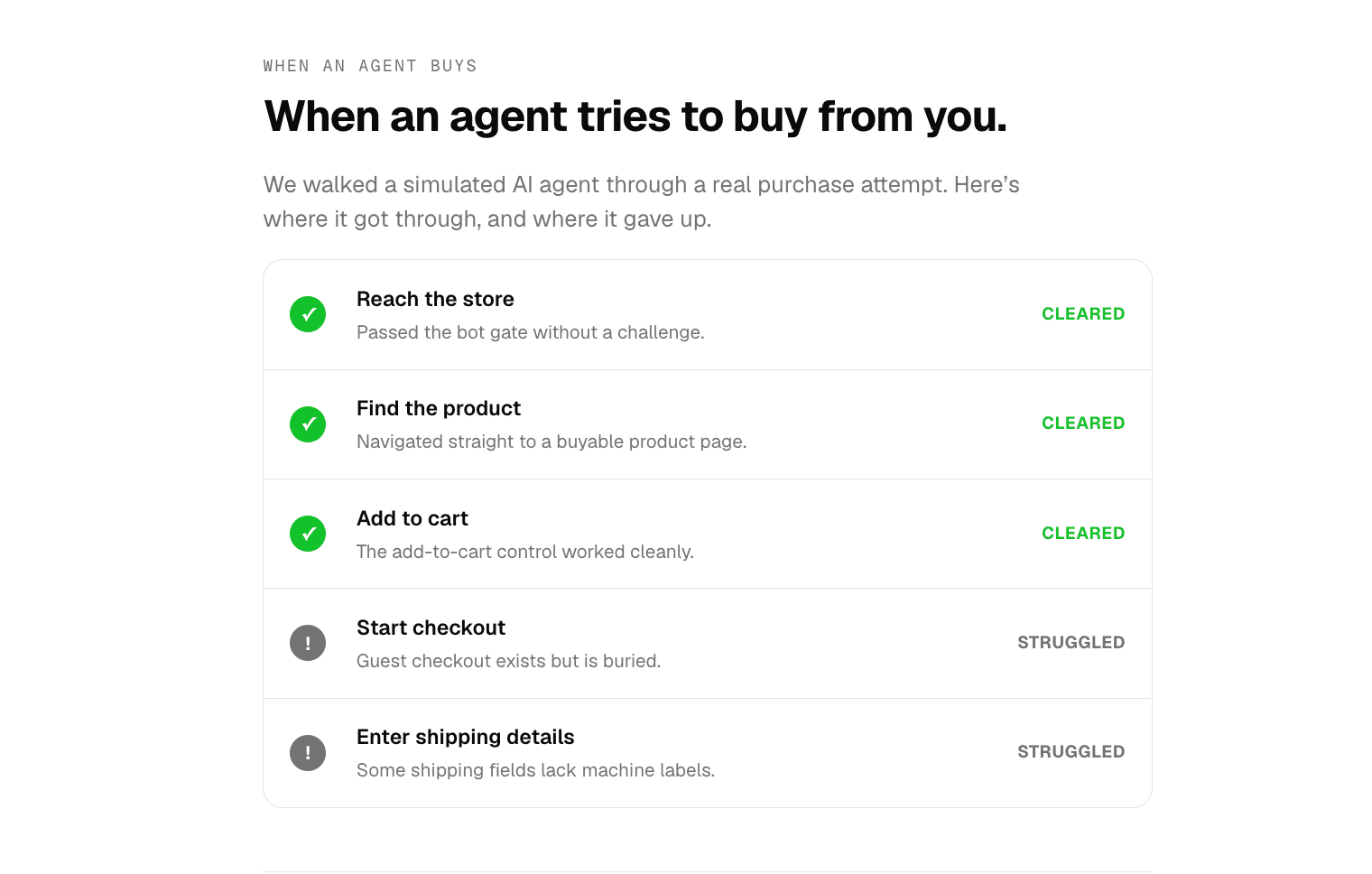
An AI agent shopping for someone has to find the merchant, understand what is for sale, and complete a purchase. A store can rank on Google and fail all three. Crawler rules written for scrapers block the models people ask for recommendations; product data that reads fine to a person carries none of the fields an agent needs; checkout flows assume someone who can read a modal. Merchants had no way to see any of it, and advisory conversations about it ran on assertion.
How it works
The tool takes a store URL and returns a scored report on two dimensions. Discoverability asks whether an agent can find and understand the merchant; transactability asks whether it can buy. Ten modules feed the score, from crawler access and structured data to checkout friction and detection of agentic payment protocols (UCP, ACP, MCP and x402).
The rubric is versioned, so a merchant whose score moved can see whether their site changed or the ruler did. And the audit runner is a standalone package with its own command line, which is what made it possible to audit a whole cohort and turn the results into a benchmark.
Results
| Across 70 stores | Discoverability | Transactability |
|---|---|---|
| Lowest | 15 | 13 |
| Lower quartile | 26 | 37 |
| Median | 30 | 56 |
| Upper quartile | 34 | 64 |
| Highest | 70 | 84 |
What 70 audits found
- Discoverability is the binding constraint, not checkout. 64 of the 70 stores score higher on transactability than on discoverability. Every store clearing 50 on discoverability also clears 50 on transactability; the reverse fails 34 times.
- None of it is visible in a browser. Robots directives, response headers, structured data and markup semantics set the discoverability score, so a page that renders well for a person can still be unreadable to an agent.
- Being mentioned and being cited are different results. Only a citation gives an agent a link to act on, so the tool separates cited from mentioned from absent, then checks whether what the model said about the merchant is true. Of the tools surveyed in mid-2026, one fired live queries and none verified accuracy.
- A score is only useful next to other scores. A merchant told they sit at 31 learns nothing. Shown 31 against a cohort median of 30, they ask the right follow-up question.
My role
Problem framing, rubric design and weighting, the ten-module scoring engine, live-model evaluation design, cohort benchmarking, report design, and the client deck and rollout collateral.